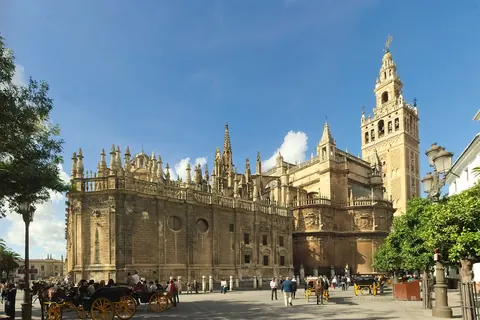
The Cathedral of Saint Mary of the See, better known as Seville Cathedral, is a Catholic cathedral in Seville, Andalusia, Spain. It was registered in 1987 by UNESCO as a World Heritage Site, along with the adjoining Alcázar palace complex and the General Archive of the Indies. It is one of the largest churches in the world and the largest Gothic cathedral.
After its completion in the early 16th century, Seville Cathedral supplanted Hagia Sophia as the largest cathedral in the world, a title the Byzantine church had held for a thousand years. The Gothic section alone has a length of 126 m, a width of 76 m, and a central nave height of 36 m (40 m at the crossing). The total height of the Giralda tower from the ground to the weather vane is 104.5 m. The Archbishop’s Palace is located on the northeastern side of the cathedral.
Seville Cathedral was the site of the baptism of Infante Juan of Aragon in 1478, only son of the Catholic Monarchs Ferdinand II of Aragon and Isabella I of Castile. Its royal chapel holds the remains of the city’s conqueror, Ferdinand III of Castile, his son and heir, Alfonso the Wise, and their descendant, King Peter the Cruel. The funerary monuments for cardinals Juan de Cervantes and Pedro González de Mendoza are located among its chapels. Christopher Columbus and his son Diego are also buried in the cathedral.
Sources
- Wikipédia (fr) : Cathédrale Notre-Dame-du-Siège de Séville
- Wikipedia (en): Seville Cathedral
- Wikidata: Q231606
- Official website
Text: introduction of the Wikipedia article Seville Cathedral, under the CC BY-SA 4.0 licence (authors: article history). Facts: Wikidata (CC0). Coordinates: Wikidata, map background © OpenStreetMap contributors.